

Europe is fighting losing battle on two fronts
“China is swallowing up a large part of German industry. The Europeans are losing almost all the rest to the Americans in the sectors of the future – AI, biotech, financial services and logistics.”
That is the sombre analysis of Dan Wang (王丹), a researcher at the Hoover Institute in Stanford University. He is the author of “Breakneck: China’s Quest to Engineer the Future”, published last year to critical acclaim.
He was speaking to L’Express magazine on the publication of the French translation of the book.
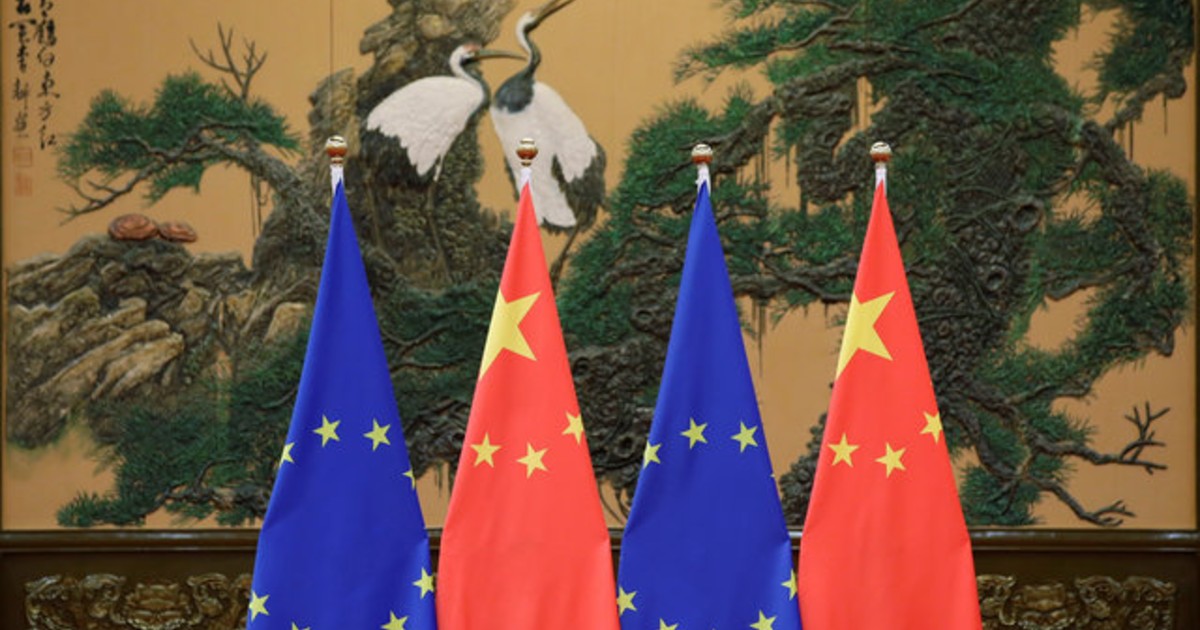
Last week EU Commissioner Maros Sefcovic was in Beijing for two days of talk to try to avert a trade war. With China’s trade surplus running at US$1 billion a day, the governments of Europe say that this flood of products is an existential threat to its manufacturing.
Wang is not hopeful. With an Austrian wife, he often visits Europe. “It has magnificent places, more beautiful and pleasant than any region in China or the U.S. But the Europeans are only optimistic when they look at the past. It is doomed to have a national and regional decline in the foreseeable future.
“Almost everywhere in the polls we see the populist parties ahead of those in power, in France and Germany. I doubt these populist parties can create more healthy economies in the future,” he said.
He sees the future as a bitter conflict between China and the U.S. “Both have made errors. With his management of Covid, Xi Jinping set off a property crisis which has gravely weakened the economy and hurt many entrepreneurs. Today he is trying to correct that.
“The Americans re-elected Donald Trump who has caused a real chaos in diplomacy, economy and domestic politics. It is always possible that one of these two countries will implode.”
He said that China remained behind the U.S. and Europe in semi-conductors and aviation. “China is a world leader in manufacturing but still behind in the sciences.”
It will take China decades, not years, to catch up in aviation with Airbus, which requires a combination of disciplines, including mechanics, materials and aerodynamics. In semi-conductors also, Europe – especially ASML – and the U.S. retain a substantial lead.
Asked about China’s pharaonic spending on new forms of energy, Wang said that the driver was not to save the plant but to gain sovereignty in energy and not depend on gas from the Middle East, the U.S. and Russia. “It is also seeking markets where it can export its own technologies. It wants to be a pioneer in the products of tomorrow, because many sectors will be electrified.”
On the minus side, coal continues to produce 60 per cent of China’s electricity. “This will probably continue until the end of the century,” he said.
Where China is weak is in soft power, domains where Japan and South Korea have excelled, selling their music, dance, films, mangas and other cultural products around the world.
“The leaders of the regime are Communists and engineers. They understand little of humour or music that would please the whole world. For them, the priority is, first, control of the country and then becoming a global superpower,” he said.
China cannot become a financial superpower because it retains capital controls. Investors do not wish to put their money where they are unsure of being able to get it back.
“China is very strong in the concrete and practical but very weak in human relations,” he said.
He does not fear a direct confrontation between the two superpowers. “As China creates better products, brands will followed, as with Japan and South Korea. There will be more mutual curiosity, a good way to avoid a direct confrontation,” he said.
When Wang and his wife visit China and the U.S., they see ugly cities, tasteless croissants and governments obsessed by power.
“What the Europeans and Japanese have are wonderful cities where it is good to live, with delicious croissants and other pastries, but no national grandeur. They are incapable of thinking of the future but prefer to cultivate an image of the past.”
Born in Yunnan in 1992, Wang was raised in Canada, where his family lived in both Ottawa and Toronto. As a teenager, he participated in the Royal Canadian Army Cadet programme in Ottawa.
He later moved to the United States. He studied economics and philosophy at the University of Rochester. He worked in China from 2017 to 2023.
-
How should leaders govern the people? Michael Chugani
A senior Mainland official once advised Donald Tsang Yam-kuen when he was the chief executive to think like the people do. It was good advice. Leaders who want to effectively serve the people need to
-

Hong Kong Tourism Board Unveils ‘Only in Hong Kong’
The Hong Kong Tourism Board (HKTB) launched ‘Only in Hong Kong’, a new global campaign that redefines how the city is experienced and differentiating Hong Kong as Asia’s World City. Moving beyond a
-
Zhang Daqian, China's Best Painter for 500 Years Mark O'Neill
At Sotheby’s art auction in Hong Kong in April this year, it put on sale three works by Zhang Daqian ( 張大千). One of them, Sunshine after Rain (雨後斜陽), sold for HK$15.36 million. It was evidence that,
-
Government celebrates success of Kai Tak Sports Park Mark O'Neill
The Hong Kong government is celebrating the success of the Kai Tak Sports Park which opened in March last year – nearly 600,000 people have attended major sports events there. In a written reply in