

Protect yourself from dual attacks of pneumococcal disease & flu
Have you ever had a fever, cough, and headache? Your instinct may make you consider it as influenza (also known as ‘flu’), however, these can also be symptoms of pneumococcal infection. How can we identify which disease it is when symptoms appear? Influenza and pneumococcal infections not only cause similar symptoms, but people could also suffer from both infections simultaneously. We invited Dr. Andrew Kong, a general practitioner, to explain the relationship between influenza and pneumococcal infections and share some tips on how to get rid of pneumococcal infections.

Dr. Andrew Kong
What are the differences between influenza and pneumococcal infections?
While people may be less aware of pneumococcal infections compared to influenza, both infections can exhibit similar symptoms and can result in severe, life-threatening complications. For instance, influenza can lead to pneumonia and respiratory distress syndrome, whereas pneumococcal infections can cause serious complication and invasive conditions such as meningitis and sepsis, which are equally dangerous.
When people get influenza, the viruses can weaken their immune systems, making pneumococcus able to invade more easily and then cause secondary infections. Therefore, influenza can also be a precursor to more severe pneumococcal infections. To prevent the situation from becoming serious, it is recommended to consult a doctor immediately when symptoms arise.
When is the peak season of pneumococcal infections?
Pneumococcal infections typically occur during winter, particularly from January to February in Hong Kong. Recently many people like travelling to different countries, especially during winter and spring, in which Christmas and Lunar New Year holidays are present. Being out-of-town may increase the chance of exposing to new strains of streptococcus pneumoniae, especially when staying in crowded environment, which facilitates the spreading of bacteria through close contact with others, such as at the airport or on planes. Therefore, it is recommended that people get vaccinated, not only to protect themselves and their families but also reduce the infections within the community.
Are there any tips for people to protect themselves and their families from pneumococcal infections?
Tip #1: Get vaccination if you are considered as high-risk groups
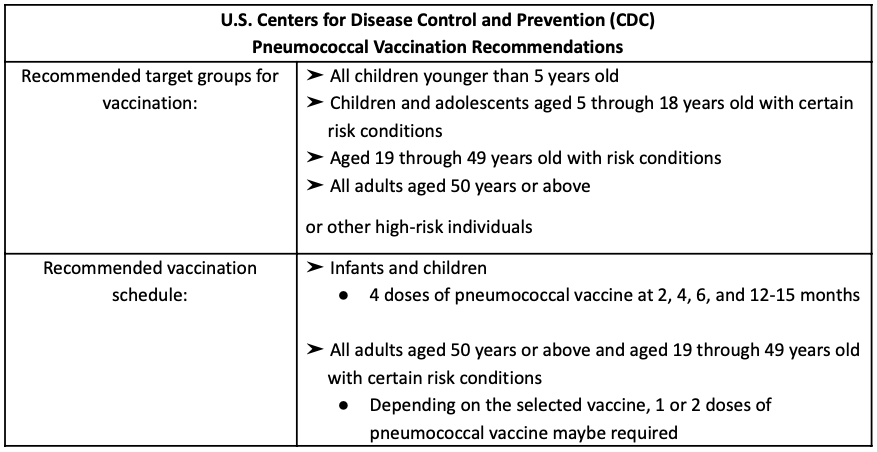
Currently, the pneumococcal vaccines protect people against serious illnesses caused by pneumococcus, such as pneumonia, meningitis, and bloodstream infection. According to the latest recommendations from U.S. Centers for Disease Control and Prevention (CDC), pneumococcal vaccination is recommended for all children younger than 5 years old, children and adolescents aged 5 through 18 years old with certain risk conditions, all adults aged 50 years or above, and those aged 19 through 49 years old with risk conditions or other high risk groups.
Tip #2: Select a pneumococcal vaccine which is suitable for you
In Hong Kong, pneumococcal conjugate vaccines (PCV13/15/20) and pneumococcal polysaccharide vaccine (PPSV23) are available to prevent pneumococcal diseases. These two types of vaccines differ not only in their composition, mechanism of action, target populations, and the breadth of protection against pneumococcal diseases, but also in their immunological memory. Pneumococcal conjugate vaccines consist of polysaccharides conjugated to a carrier protein, enabling them to stimulate the immune system to produce antibodies and induce long-term immunological memory. In contrast, polysaccharide vaccines consists of free polysaccharides, which only elicit a short-term immune response and could not provide long-lasting immunological memory. As a result, pneumococcal conjugate vaccines offer more long-term protection.
The “valent” of vaccines reflects the number of serotypes covered by vaccines, such as PCV20, which is the most extensive serotype coverage among pneumococcal conjugate vaccines available in Hong Kong and it can protect us against 20 serotypes after vaccination. When choosing pneumococcal vaccines, on top of the number of serotypes covered, other key factors should also be considered, including local epidemiology of pneumococcal serotypes, age and health condition, effectiveness of vaccines in preventing invasive pneumococcal diseases (IPDs), schedule of vaccination and dosing requirements, etc. Taking the local data before the Covid-19 outbreak as an example, the most common serotype causing invasive pneumococcal disease in Hong Kong was serotype 3, which accounted for about half of the total number of cases (This serotype is covered by all pneumococcal vaccines in Hong Kong).
However, with the gradual cancellation of various pandemic measures in recent years, social and travel activities have become more frequent, leading to a rising trend in cases of invasive pneumococcal disease. Some cases involve serotypes that were not fully covered by past vaccines, such as 8, 11A, and 15B. To further mitigate the risk of infection, it is recommended to consider vaccines that cover a broader range of serotypes to provide more comprehensive and effective protection.
Tip 3: Maintaining good hygiene and healthy lifestyle
On top of vaccination, people could protect themselves and their families with good hygiene, including regular handwashing, avoiding close contact with sick individuals, and covering their mouth and nose when coughing or sneezing. Also, people could maintain healthy lifestyle to strengthen the immune system and hence protect them from pneumococcal infection. Maintaining a balanced diet, exercising regularly, and getting adequate sleep are helpful. And to reduce the risk of respiratory infections, it is also important to avoid smoking and limit exposure to secondhand smoke.
Do I need to receive pneumococcal vaccines annually like influenza vaccines?
Unlike influenza vaccines, people do not need to receive pneumococcal vaccines every year. The schedule of vaccination varies among different vaccines. Taking PCV20 as an example, according to the latest guidelines from the CDC, healthy adults aged 50 and above, and aged 19 through 49 years old with certain risk conditions need a single dose of PCV20 to complete their pneumococcal vaccination, while people who take PCV13 or PCV15 may require a follow-up dose of PPSV23 one year later for full protection.
In order to provide protection, the vaccines may take about 2 to 3 weeks for the body to develop antibodies. Hence, the high-risk groups may benefit from co-administering pneumococcal vaccine and seasonal influenza vaccine during a single clinic visit for enhanced protection, avoid the combined presence of influenza virus and pneumococcal bacteria which can lead to dual infections as well as serious health consequences.
The above information is provided by Dr. Andrew Kong, General Practitioner, and this article is supported by Pfizer Corporation Hong Kong Limited
PP-PNR-HKG-0548 Jun 2025
-
How should leaders govern the people? Michael Chugani
A senior Mainland official once advised Donald Tsang Yam-kuen when he was the chief executive to think like the people do. It was good advice. Leaders who want to effectively serve the people need to
-

Hong Kong Tourism Board Unveils ‘Only in Hong Kong’
The Hong Kong Tourism Board (HKTB) launched ‘Only in Hong Kong’, a new global campaign that redefines how the city is experienced and differentiating Hong Kong as Asia’s World City. Moving beyond a
-
Zhang Daqian, China's Best Painter for 500 Years Mark O'Neill
At Sotheby’s art auction in Hong Kong in April this year, it put on sale three works by Zhang Daqian ( 張大千). One of them, Sunshine after Rain (雨後斜陽), sold for HK$15.36 million. It was evidence that,
-
Government celebrates success of Kai Tak Sports Park Mark O'Neill
The Hong Kong government is celebrating the success of the Kai Tak Sports Park which opened in March last year – nearly 600,000 people have attended major sports events there. In a written reply in