

China to build Most Costly, Difficult Railway

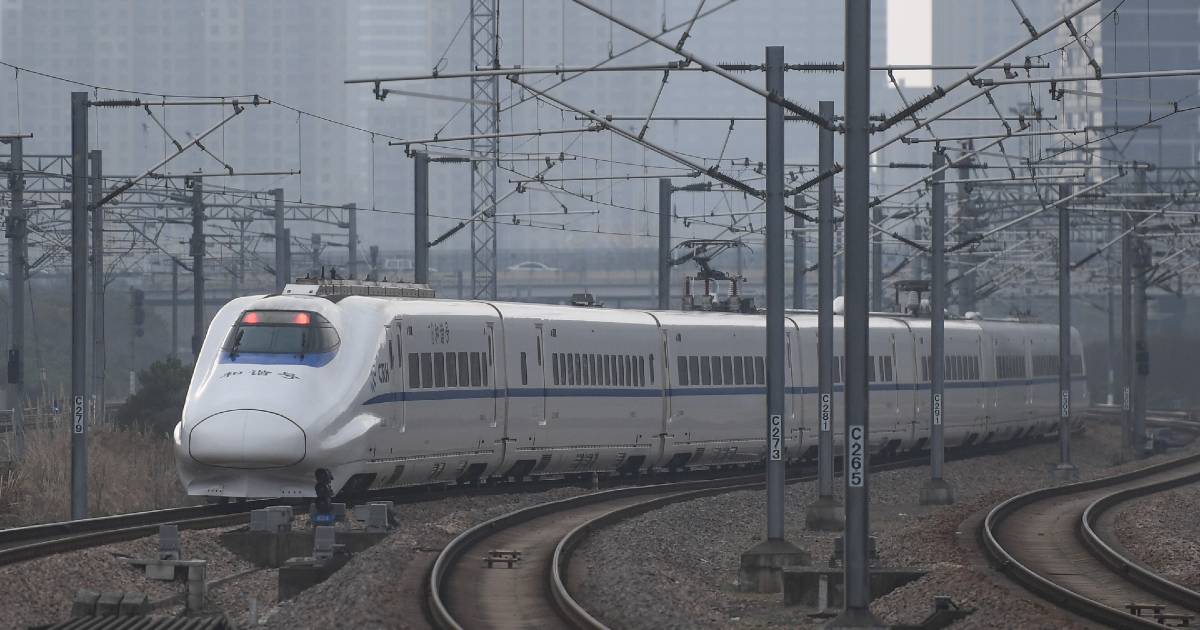
This month China announced that it would build the most expensive railway in the world, and also technically the most difficult, to link its two most remote regions.
The new line will run from Hotan in Xinjiang province to Shigatse in Tibet, a distance of 2,000 kilometres. It will cost 400 billion yuan, or 200 million per kilometre. It will pass through mountains, glaciers, frozen rivers and permafrost. Of the line, 62 per cent will consist of bridges and tunnels.
Construction will begin in November this year and is due to take 10 years. Trains will travel at 120-160 kilometres an hour.
The Xinjiang-Tibet Railway Company was established on August 7, with a registered capital of 95 billion yuan. All the money is coming from the state-owned National Railway Group.
The price tag makes it more than double that of the most expensive line currently under construction – a high-speed railway of 679 kilometres from Moscow to St Petersburg that is costing US$25.3 billion.
The line will never earn a commercial return on this Pharaonic investment. Beijing has bigger objectives.
“Many places in the western regions are undeveloped and the major strategic channels to enter and leave Tibet and Xinjiang need to be strengthened,” said Liu Wenxian, a senior official of the planning department of the China Railway Group.
“The priority is to strengthen the construction of strategic links and effectively guarantee the implementation of major national strategies,” he said.
This means defence against India and possible uprisings by Uighurs or Tibetans, the encouragement of Han settlement and quicker development of the mineral and other resources and economies of the two regions.
The line will run through Aksai Chin, a region, occupied by China but claimed by India since 1959, and close to the Line of Actual Control (LAC), which marks the disputed border between India and China. The line will dramatically improve Beijing’s ability to bring troops and equipment to the LAC.
The second objective is to encourage Han settlement, as in Xinjiang. In the 1953 census, its population was 4.87 million, of whom 75 per cent were Uighur and six per cent Han. In 2020, the population reached 25.85 million, 45 per cent Uighur and 42 per cent Han. Han have become the majority in the northern, and more developed, half of Xinjiang.
Beijing is encouraging Han settlement in southern Xinjiang, where Hotan is located. The south of the region is where opposition to Chinese rule is strongest.
Since the 1950s, the Xinjiang Production and Engineering Corps has been Beijing’s main instrument for Han settlement. It has established its 14th division in Hotan. In a policy paper in 2003, it said there were only five districts in Xinjiang where Uyghurs still accounted for more than 50 per cent of the population.
“We should consider the Israeli model and encourage mass migration for Han to these areas, in land that is unoccupied. We should use water resources to improve economic development and the living standards of Uyghurs, to restrict the space for terrorism,” it said.
In the 2020 census, the population of Tibet was 3.65 million, of whom Tibetans accounted for about 90 per cent, with 10 per cent Han and other minorities.
Han people do not want to live in Tibet, because of its remoteness, high altitude, severe climate, unfamiliar cuisine and lack of economic opportunities.
The new line will make Tibet more attractive to Han, by establishing towns and factories linked to the 35 stations on the line.
Railways to Tibet are comparable to the Pacific Railroad in the U.S. built in the 1860s. It enabled tens of thousands of white settlers to move to western states for farming, mining and jobs in towns and cities. It enabled factories on the Pacific Ocean to transport their goods easily to the Eastern Seaboard, for export to Europe.
The first railway to Tibet, from Xining to Lhasa, opened in 2006. With over 960 kilometres above 4,000 metres above sea level, it is the highest railway in the world. Beijing is planning two other new lines to Tibet, from Sichuan and Yunnan respectively. The Sichuan line is due to open in 2032.
With such a rail network, who can oppose Chinese rule?
-

How should leaders govern the people? Michael Chugani
A senior Mainland official once advised Donald Tsang Yam-kuen when he was the chief executive to think like the people do. It was good advice. Leaders who want to effectively serve the people need to
-

Hong Kong Tourism Board Unveils ‘Only in Hong Kong’
The Hong Kong Tourism Board (HKTB) launched ‘Only in Hong Kong’, a new global campaign that redefines how the city is experienced and differentiating Hong Kong as Asia’s World City. Moving beyond a
-

Zhang Daqian, China's Best Painter for 500 Years Mark O'Neill
At Sotheby’s art auction in Hong Kong in April this year, it put on sale three works by Zhang Daqian ( 張大千). One of them, Sunshine after Rain (雨後斜陽), sold for HK$15.36 million. It was evidence that,
-
Government celebrates success of Kai Tak Sports Park Mark O'Neill
The Hong Kong government is celebrating the success of the Kai Tak Sports Park which opened in March last year – nearly 600,000 people have attended major sports events there. In a written reply in