

Hit by Trump tariffs, Irish distillers look to Asia

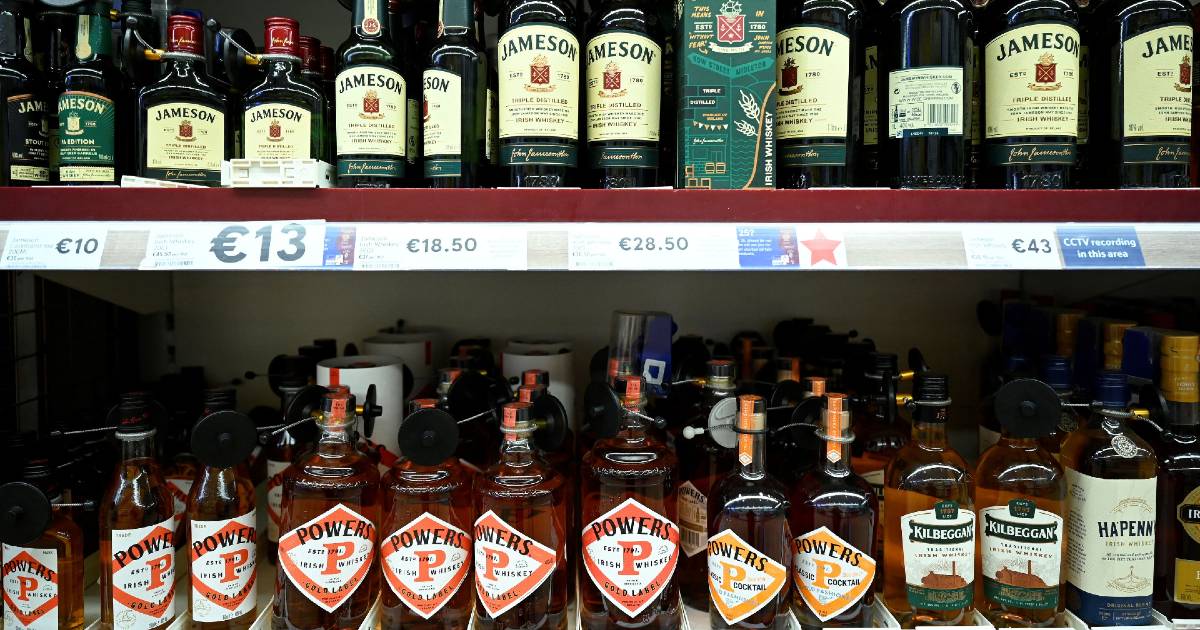
Hit by the tariffs imposed by Donald Trump, Irish whiskey distillers are looking to the Asian market, especially China and India.
In 2024, Irish whiskey exports reached over one billion euros, an increase of 13 per cent over 2023. Since 2010, global sales have tripled.
“Exports to China grew 33 per cent last year,” said Jennifer Bourke, Irish consul-general, told a reception for visiting distillers. “Asia is a very big growth area. 2025 has been a challenging year, with the 15 per cent tariff imposed by President Trump on EU products.”
The U.S. is the largest export market for Irish whiskey. “Last year Hong Kong decreased the tariffs on imported spirits from 100 per cent to just 10 per cent. Hong Kong has the world’s best bar,” she said.
That is Bar Leone in the Sheung Wan district, owned by Lorenzo Antinori, a native of Rome. A UK-based organisation, World’s Best Group, issues a ranking each year and named Bar Leone top last month.
The reception was in honour of three distillers – Lough Ree, Dingle and Walsh Whiskey – who are attending the 17th Hong Kong TDC International Wine & Spirits Fair, held from November 6-8 at the Hong Kong Convention and Exhibition Centre in Wanchai.
More than 620 exhibitors from 23 countries and regions, including the Mainland, Australia, Czechia, Germany, Ireland, Italy, Japan, Portugal and Spain, are taking part.
Peter Clancy, CEO and founder of Lough Ree, said Irish distillers were looking at new markets like Japan, Nigeria and India, where exports grew 57 per cent last year. “We are suffering from U.S. tariffs. These are challenging times for the industry. New markets are important.”
Ireland is home to more than 50 distilleries, north and south, up from two in 1966. They sell to more than 120 markets worldwide.
Clancy and two siblings established Lough Ree in 2018 in their native town of Lanesborough, Co Longford in the centre of Ireland, on the shores of the Shannon river. It has a population of 2,000.
“Our products are all different,” he said. “The disposable income of people is increasing. You must give them more choice.” They sell in Hong Kong for between HK$500 and HK$1,000.
One characteristic of the industry in Ireland is the widespread use of copper stills in the distilling process. Copper absorbs sulphur compounds and yeast cells produced during fermentation, preventing the production of toxic chemicals in the distillate. Copper is seen to improve the quality, aroma and taste of the end product.
Many Irish whiskeys, particularly the single pot still style, are triple-distilled in copper pot stills, a technique that contributes to their signature character.
In October 2024, Chief Executive John Lee announced a cut in its spirits tax from 100 per cent to just 10 per cent, to stimulate tourism and generate revenue.
The 100 per cent tax remains on a bottle up to HK$200. But, for that portion of the price above HK$200, the tax is only 10 per cent. That means enormous savings on high-end, high-quality spirits, including whiskey and baijiu.
The Asian whisky market is estimated at US$33.8 billion a year. “The Irish whiskey sector is seeing a global resurgence with increasing exports and ongoing investment,” said Padraig Seif, president of the Irish Chamber of Commerce in Hong Kong.
Irish whiskey is one of the oldest spirits in Europe, with distillation since the sixth century.
In 1324, the Red Book of Ossory was written by the then bishop, Richard Ladrede, and published in the medieval city of Kilkenny.
The Red Book holds the earliest recorded recipe for distilling Aqua Vitae, used for medicinal purposes as the Black Death ravaged Europe. The 'water of life' is known as whiskey today. In Gaelic, it was called “Uisce Beatha”, which became “whisky” in English.
By the 19th century, Ireland was supplying 60 per cent of world demand, mostly due to access to overseas markets of the British Empire. To differentiate it from other whiskies, the Irish producers added the “e” to show the traditional pot still distillation method they used. Between 1823 and 1900, whiskey output in Ireland increased fourfold.
But, in the early 20th century, Prohibition in the U.S., natural disasters and geopolitical tensions caused a decline in exports. A trade war with Britain after Independence in 1922 cut off the British and Commonwealth markets. This enabled Scotch to overtake Irish whiskey as the number one exporter.
Asked when Ireland would overtake Scotland and became number one exporter again, Clancy said that would take many years. “Our exports last year were one billion euros, those of Scotch 5.4 billion pounds.”
-
How should leaders govern the people? Michael Chugani
A senior Mainland official once advised Donald Tsang Yam-kuen when he was the chief executive to think like the people do. It was good advice. Leaders who want to effectively serve the people need to
-
Hong Kong Tourism Board Unveils ‘Only in Hong Kong’
The Hong Kong Tourism Board (HKTB) launched ‘Only in Hong Kong’, a new global campaign that redefines how the city is experienced and differentiating Hong Kong as Asia’s World City. Moving beyond a
-
Zhang Daqian, China's Best Painter for 500 Years Mark O'Neill
At Sotheby’s art auction in Hong Kong in April this year, it put on sale three works by Zhang Daqian ( 張大千). One of them, Sunshine after Rain (雨後斜陽), sold for HK$15.36 million. It was evidence that,
-
Government celebrates success of Kai Tak Sports Park Mark O'Neill
The Hong Kong government is celebrating the success of the Kai Tak Sports Park which opened in March last year – nearly 600,000 people have attended major sports events there. In a written reply in