
Europe trembles at approach of Le Pen presidency

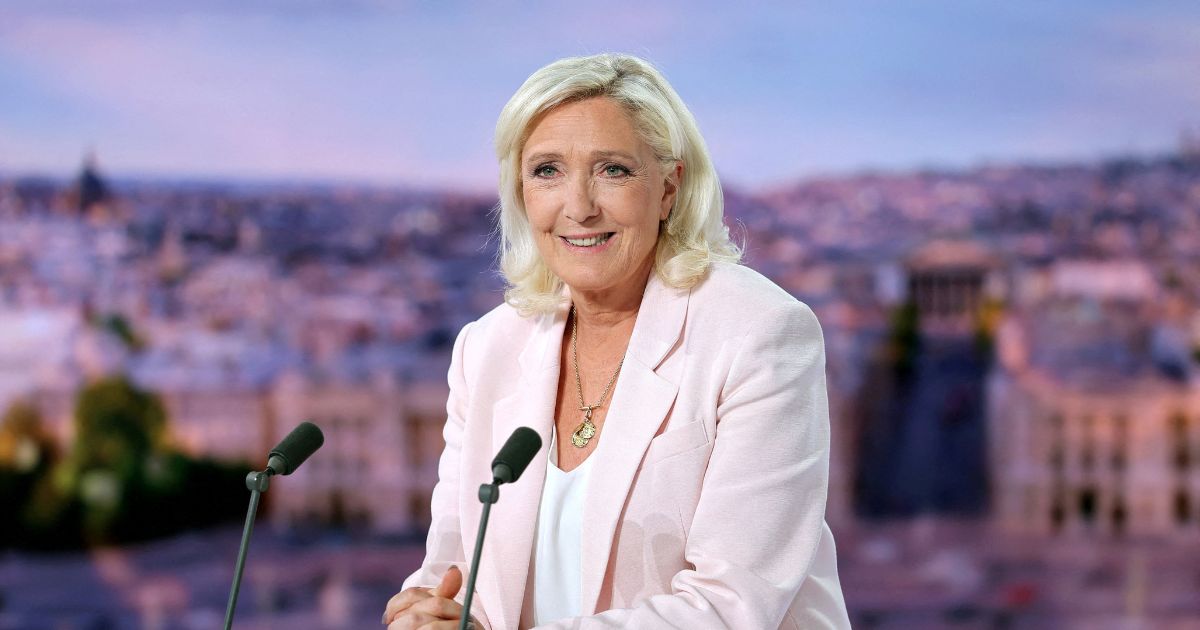
Marine Le Pen is on course to become France’s most right wing president since 1945 – and Europe is trembling.
The presidential election will be held on April 18 and May 2 next year. If no candidate wins more than 50 per cent in the first round, the top two will go through to the second round.
An opinion poll published at the end of September found Le Pen in first position with 35-36 per cent of the votes, followed by far-left candidate Jean-Luc Melenchon with 17-18 per cent and centrist and former Prime Minister Edouard Philippe with 13-16 per cent.
It found that, in a second round, Le Pen would beat both of them, with 69 per cent against Melenchon and 57 per cent against Philippe.
The poll was conducted by Ipsos-BVA. Brice Teinturier is its director-general: “We have reached a level of anger where 85 per cent of French believe that the country is in decline. They blame mistakes made over the last 40 years by their leaders. All the ingredients are there for a populist turnover.
“Ten years ago, Britain experienced this with the vote on Brexit and the U.S. with the first win of Trump. France has long considered itself spared of such populism has discovered with shock the level of anger and dissatisfaction, because of economic setbacks and political paralysis,” he said.
This will be Le Pen’s fourth attempt to become president. In 2012, 2017 and 2022, she won 17.9 per cent, 33.9 per cent and 41.5 per cent of the votes respectively. In the last two, she made it into the second round, losing each time to Emmanuel Macron.
The only way Le Pen will lose would be if the centre and centre left found a single candidate more popular and competent. Several people are competing for this position but so far none is good enough to defeat her.
Such is the alarm among the country’s political and business establishment over a Le Pen presidency that they are looking for outside candidates.
On September 28, ex-Socialist President Francois Hollande, 72, said he might decide to run for president in 2027. He was head of state from 2012 to 2017.
“We are facing a more threatening, more dangerous and harsher world, and a European continent that has become a target for powers such as the United States, China and Russia. Europe is confronting an existential crisis … I will consider running only under exceptional circumstances and only if there was a realistic chance of reaching the runoff and winning.”
Eric Chol is editor-in-chief of L’Express, a mainstream centre-right weekly magazine. In an editorial in this week’s issue, he compared the moment to September 20, 1938, when French Prime Minister Edouard Daladier returned to Paris airport after signing the Munich Agreement that handed Czechoslovakia over to Adolf Hitler.
While the crowd cheered him for averting a war, Daladier said: “Ah, the fools! If only they knew.”
If Le Pen won, it would be a revolutionary change. She would pass a policy prioritising French citizens over foreigners for employment, social benefits, housing and healthcare. She would introduce a strict moratorium on legal immigration, end laws that allow undocumented immigrants to earn legal residency and heavily cut welfare benefits for non-citizens.
She would restore rigid, permanent borders, trying to bypass or withdraw France from the border-free Schengen Area. This would put her on a collision course with the European Union (EU).
She would rule that French national law always overrode EU directives and European court rulings. She would threaten to withhold or unilaterally reduce France’s financial contributions to the EU budget.
She would remove France from NATO’s integrated military command structure – this would fracture Western military unity.
She is less specific on how to cut France’s national debt. As of the end of June this year, it reached 119 per cent of GDP, the highest level since 1945. The government has forecast that it will reach 121.7 per cent in 2027.
To bring it down would require deep cuts in education, housing, pensions, welfare and other areas important to Le Pen’s electorate.
The financial markets are sceptical of a future Le Pen government. On October 1, the French Treasury issued €12 billion in long-term bonds during the auction it holds on the first Thursday of each month. The interest rate on a 10-year bond was 4.93 per cent. In September, the average rate for Treasury issuances was 4.32 per cent. On August 6, one issuance sold at 3.86 per cent -- a jump of more than one percentage point in just two months.
On secondary markets, French interest rates reached 4.95 per cent last Thursday, their highest level since 2002. That marks a 1.4 percentage point increase in just three months.
As Marine Le Pen moves closer to power, Europe is trembling.
-
How should leaders govern the people? Michael Chugani
A senior Mainland official once advised Donald Tsang Yam-kuen when he was the chief executive to think like the people do. It was good advice. Leaders who want to effectively serve the people need to
-

Hong Kong Tourism Board Unveils ‘Only in Hong Kong’
The Hong Kong Tourism Board (HKTB) launched ‘Only in Hong Kong’, a new global campaign that redefines how the city is experienced and differentiating Hong Kong as Asia’s World City. Moving beyond a
-
Zhang Daqian, China's Best Painter for 500 Years Mark O'Neill
At Sotheby’s art auction in Hong Kong in April this year, it put on sale three works by Zhang Daqian ( 張大千). One of them, Sunshine after Rain (雨後斜陽), sold for HK$15.36 million. It was evidence that,
-

Government celebrates success of Kai Tak Sports Park Mark O'Neill
The Hong Kong government is celebrating the success of the Kai Tak Sports Park which opened in March last year – nearly 600,000 people have attended major sports events there. In a written reply in