
HK Ballet’s Premiere of Dunhuang

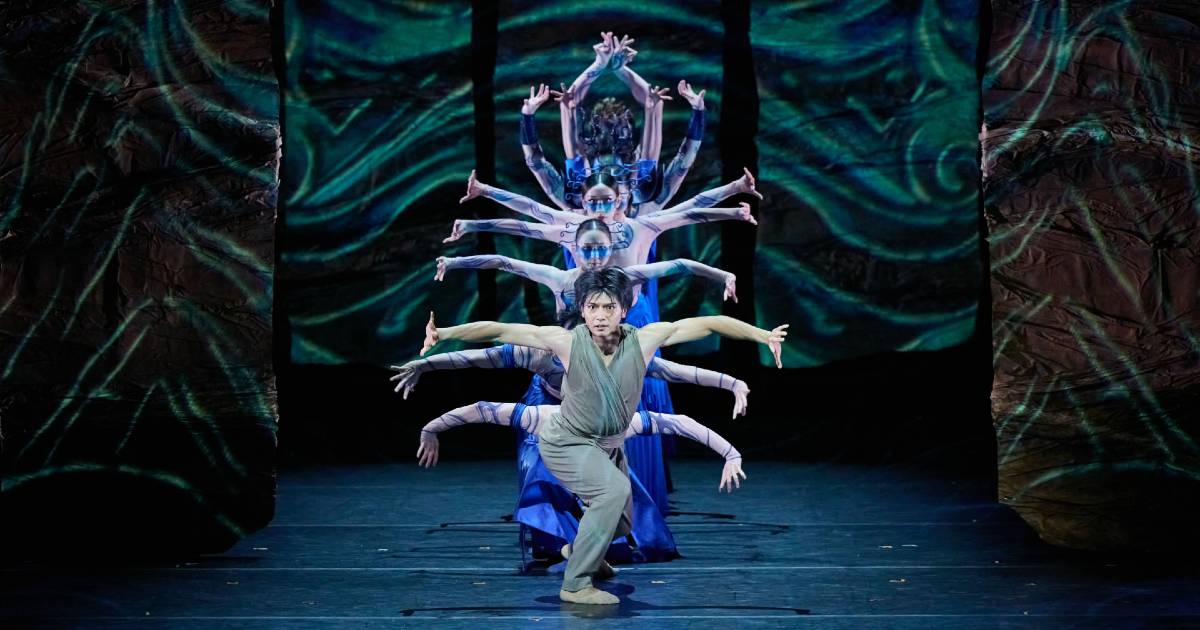
Hong Kong Ballet opened its new 2026/2027 season in mid-October with the premiere of a new ballet “Dunhuang: In Search of Light” jointly choreographed by Ricky Hu, the company’s choreographer-in-residence, and his wife Mai Jingwen. Their last ballet for the company was “The Butterfly Lovers” premiered in 2024.
This new work “Dunhuang” is based on the famed 1922 novel “Siddhartha” by the German author Hermann Hesse. It traces Siddhartha’s spiritual journey from downfall to awakening and finally to ultimate enlightenment. The story is transposed to Dunhuang, which was once a frontier military town on the Silk Road. The famous murals of the Dunhuang Mogao Caves are evoked by videos projected onto the side of the auditorium. This two-hour-long ballet has a prologue and two acts, and is set to a new score by Tian Mi.
The prologue, with a large Buddha head in the background, sees Siddhartha looking back and coming to terms with his life in the past. Act 1 has six scenes, begins in the market square. Then the characters gradually appear – a rich Indian merchant, a beautiful woman Mara to whom Siddhartha is attracted. Mara and her female companions tempt him and he is drunk. The next scene introduces a deer who represents Siddhartha’s conscience, but he succumbs to his desires and lust. He later joins a monastery. Act 1 is overly long and finally ends with Mara noticing her pregnancy.
Act 2, which also has six scenes but is fortunately shorter, sees Siddhartha meditating in the monastery and trying to seek spiritual guidance. Then he sees Mara and their Son. Unfortunately Mara then dies after having suffered a long illness, leaving her Son to mourn her. The Son resists and resents Siddhartha. Siddhartha is then comforted by the Water-Moon Guanyin. The final scene sees Siddhartha merging into a golden light and attaining spiritual enlightenment.
The choreography is competent overall, but without much originality. Siddhartha is on stage for most of the show, and has endless solos. There is also a number of duets for Siddhartha with Mara, and for Siddhartha and his Son. The slightly restrained first duet for Siddhartha when he first meets Mara in the beginning of Act 1 contrasts with their second duet at the end of the act which is soaring and has plenty of lifts.
In Act 2, the trio for Siddhartha, Mara, and their Son is quite emotional and dramatic. However, the melodramatic duet for Siddhartha and his angry Son after Mara’s death is too long-winded.
Some of the ensemble dances are quite pleasing, for instance the female dance of the Feitians in the beginning of Act 1, and the dance of the poplar maidens in Act 2. In the market scene in Act 1, the dance with the long benches recalls Balanchine’s masterpiece “The Prodigal Son”.
Act 1 tries to cram in too much of the story, and the narration is sometimes unclear. The scene half-way for Siddhartha and the Deer is a muddle. Also unclear is the scene when he is bathed in red lighting which supposedly represents his inner struggle. A careful reading of the synopsis before the performance is strongly advisable.
Act 2 fares slightly better. The best scene is towards the end of Act 2 which shows the apparition of the Water-Moon Guanyin. It is simple and memorable. However, the concluding scene with a shower of gold dust is cheap and gaudy, and befits a television variety show instead. And the perfunctory reappearance of Siddhartha, the Son, Mara and other characters before the curtain fall does not provide a satisfying enough climax.
On the first night, Gouta Seki was excellent as Siddhartha, both in his dancing and acting. Ye Feifei was superb as Mara. Wei Wei had authority as the Ferryman who represents the passage of time, while Jeremy Chan was convincing as the Son.
The music of Tian Mi, well played by the Hong Kong Sinfonietta under the baton of Vivian Ip, is not particularly conducive to dance however. The costumes designed by Dieuweke Van Reij are colourful.
“Dunhuang: In Search of Light” is undoubtedly an ambitious production, but the overall result is uneven. Incidentally, the Hong Kong Ballet just signed an agreement with the West Kowloon Cultural District, and is scheduled to move there early next year.
Photo – by Conrad Dy-Liacco
Dancer – Gouta Seki
-
How should leaders govern the people? Michael Chugani
A senior Mainland official once advised Donald Tsang Yam-kuen when he was the chief executive to think like the people do. It was good advice. Leaders who want to effectively serve the people need to
-
Hong Kong Tourism Board Unveils ‘Only in Hong Kong’
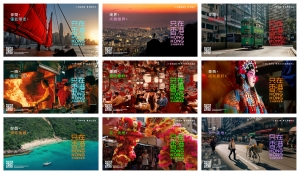
The Hong Kong Tourism Board (HKTB) launched ‘Only in Hong Kong’, a new global campaign that redefines how the city is experienced and differentiating Hong Kong as Asia’s World City. Moving beyond a
-
Zhang Daqian, China's Best Painter for 500 Years Mark O'Neill
At Sotheby’s art auction in Hong Kong in April this year, it put on sale three works by Zhang Daqian ( 張大千). One of them, Sunshine after Rain (雨後斜陽), sold for HK$15.36 million. It was evidence that,
-
Government celebrates success of Kai Tak Sports Park Mark O'Neill
The Hong Kong government is celebrating the success of the Kai Tak Sports Park which opened in March last year – nearly 600,000 people have attended major sports events there. In a written reply in